2026 — 2027
Package 1 · Sense
R2S Education
Gamified e-learning, baseline surveys, school pilots, and first measurement of students' traffic-safety knowledge and behaviours.
A research-to-society traffic-safety laboratory built on four packages — Sense, Engage, Evolve, and Extension — that equip Vietnamese adolescents, schools, families, and authorities with evidence-based learning, virtual reality practice, and spatial analytics for safer streets.
SEE Living Lab is a pioneering platform dedicated to road safety — using gamification, immersive VR, eye-tracking, and machine learning to help road users identify hazards, build safe behaviours, and create lifelong responsible habits. As one of the first specialised road safety research labs in Vietnam, the lab generates actionable, evidence-based insights that directly support policymakers in designing effective interventions.

SEE Living Lab develops evidence and interventions for safer road users, safer infrastructure and safer mobility behaviour in Vietnam's mixed-traffic, motorbike-dependent context.
A gamified e-learning platform teaching traffic rules, risk perception and safe-riding behaviour to secondary-school adolescents. Built on published research and validated with Vietnamese students.
An immersive virtual-reality cycling simulator lets learners practise scanning, signalling and hazard response in realistic urban scenes — without the risk of real traffic.
A GIS-based dashboard mapping crash clusters, school catchments, and child-friendly walkability — translating behavioural evidence into street-level policy insight.
A transferable framework scaling R2S learning and analytics to new cities and partner nations (India, Nepal, ASEAN), turning local evidence into comparable regional policy.
The LELP platform is built across four sequenced work packages, each translating behavioural observation into evidence and technology, culminating in a cross-city living lab by 2030.
Gamified e-learning, baseline surveys, school pilots, and first measurement of students' traffic-safety knowledge and behaviours.
Hybrid VR simulator for hazard perception, scanning, signalling, and safe route practice in realistic urban traffic scenarios.
Spatial analytics connecting school catchments, crash clusters, walkability audits, and LELP location data for route-level insight.
Cross-city living lab expansion across Vietnam and partner contexts, turning local evidence into comparable policy guidance.
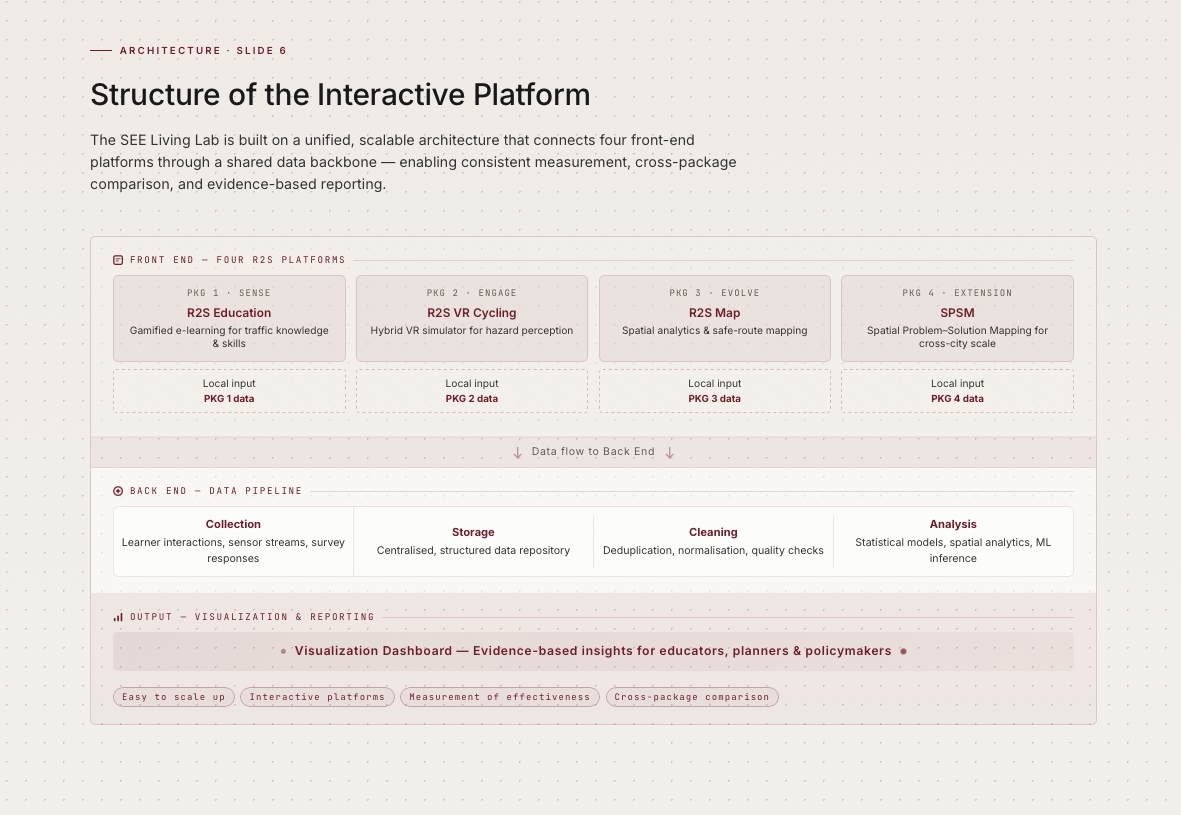
The SEE Living Lab is built on a unified, scalable architecture that connects four front-end platforms through a shared data backbone — enabling consistent measurement, cross-package comparison, and evidence-based reporting.
SEE Living Lab is organised as a portfolio: broad research topics define the scientific direction, platform packages translate those topics into measurable tools, and two flagship projects are currently being developed as the first visible products of the lab.
SEE Living Lab được tổ chức như một danh mục nghiên cứu: các chủ đề tổng định hướng khoa học, các gói nền tảng chuyển chủ đề thành công cụ đo lường, và hai dự án phát sáng đang được phát triển như những sản phẩm vận hành đầu tiên của phòng lab.
Risk perception, hazard anticipation, rule compliance, adolescent mobility behaviour, education and coaching.
Nhận thức rủi ro, dự báo nguy hiểm, tuân thủ luật, hành vi di chuyển của thanh thiếu niên, giáo dục và huấn luyện.
Crash clusters, near-miss evidence, school catchments, safe-route design, intervention evaluation and planning insight.
Cụm tai nạn, bằng chứng suýt va chạm, vùng trường học, thiết kế tuyến an toàn, đánh giá can thiệp và thông tin cho quy hoạch.
Computer vision, sensor fusion, simulation, gamification, dashboards, digital coaching and evidence-based feedback.
Thị giác máy tính, kết hợp cảm biến, mô phỏng, game hoá, dashboard, huấn luyện số và phản hồi dựa trên bằng chứng.
The architecture turns each learning interaction, sensor stream, survey response and spatial record into comparable data. This makes it clear which sub-topics are already operating, and which areas remain open for new proposals.
Kiến trúc này chuyển tương tác học tập, dòng dữ liệu cảm biến, phản hồi khảo sát và dữ liệu không gian thành dữ liệu có thể so sánh. Nhờ vậy người xem biết phần nào đã vận hành, phần nào còn mở để đề xuất thêm.
Gamified e-learning for traffic knowledge, rules, risk perception and peer learning.
E-learning game hoá về kiến thức giao thông, luật, nhận thức rủi ro và học tập cùng bạn bè.
Improved VR Cycling: a real bicycle inside a projected/LED room for measurable hazard-response practice.
Bản cải tiến của VR Cycling: xe đạp thật trong phòng chiếu/LED để luyện và đo phản ứng trước nguy hiểm.
LELP belongs here: it turns route, survey, school and intervention data into the EVOLVE layer, then feeds R2S Map and dashboards.
LELP nằm trong gói này: nó chuyển dữ liệu tuyến đường, khảo sát, trường học và can thiệp thành lớp EVOLVE, rồi đưa vào R2S Map và dashboard.
Spatial Problem-Solution Mapping for scaling the model across cities, schools and partner countries.
Spatial Problem-Solution Mapping để mở rộng mô hình qua nhiều thành phố, trường học và quốc gia đối tác.
Other sub-topics can be added as future proposals. For now, the lab gives priority to one controlled-room instrument and one field-learning platform so that education, behaviour, spatial data and policy can be connected.
Các sub-topic khác có thể được bổ sung như đề xuất mới. Hiện tại lab ưu tiên một công cụ trong phòng kiểm soát và một nền tảng học tập ngoài hiện trường để kết nối giáo dục, hành vi, dữ liệu không gian và chính sách.
Conventional traffic education can teach rules and awareness, but the failure point appears when a learner knows the rule yet lacks the embodied skill to handle an emerging hazard. SEE closes that gap by moving learners from classroom knowledge into instrumented practice, then into PKG 3 evidence through LELP and R2S Map.
Giáo dục giao thông truyền thống có thể dạy luật và nhận biết nguy cơ, nhưng điểm đứt gãy xuất hiện khi người học biết luật mà vẫn thiếu kỹ năng xử lý nguy hiểm đang phát sinh. SEE lấp khoảng trống đó bằng cách đưa người học từ kiến thức lớp học sang thực hành có đo lường, rồi chuyển dữ liệu vào PKG 3 qua LELP và R2S Map.
Classroom education can move learners from “no knowledge” to “recognition”. The missing layer is embodied practice: signalling, slowing down, choosing a lane and reacting under pressure.
Lớp học có thể đưa người học từ “chưa biết luật” sang “nhận biết nguy cơ”. Lớp còn thiếu là thực hành bằng cơ thể: ra tín hiệu, giảm tốc, chọn làn và phản ứng khi có áp lực.
R2S Immersive Cycling turns dangerous moments into repeatable scenarios. The learner remains visible, so researchers can measure head checks, hand signals, braking, steering and hazard response.
R2S Immersive Cycling biến tình huống nguy hiểm thành kịch bản có thể lặp lại. Người học vẫn hiện diện trong phòng, nên nhóm nghiên cứu đo được quay đầu quan sát, tín hiệu tay, phanh, đánh lái và phản ứng trước nguy cơ.
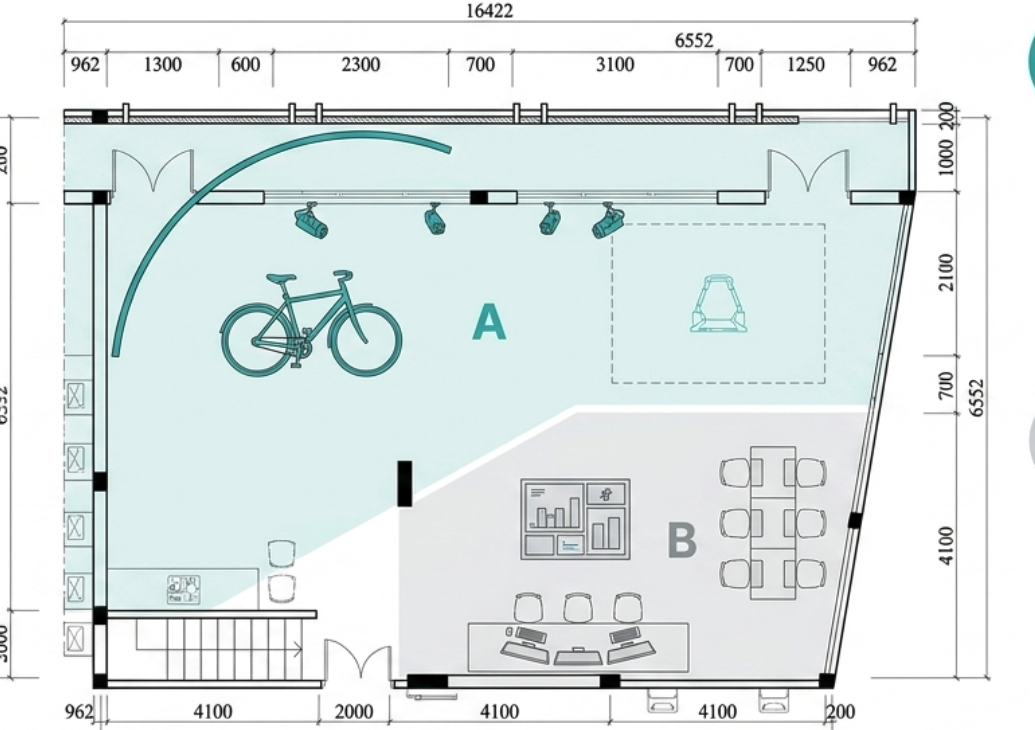
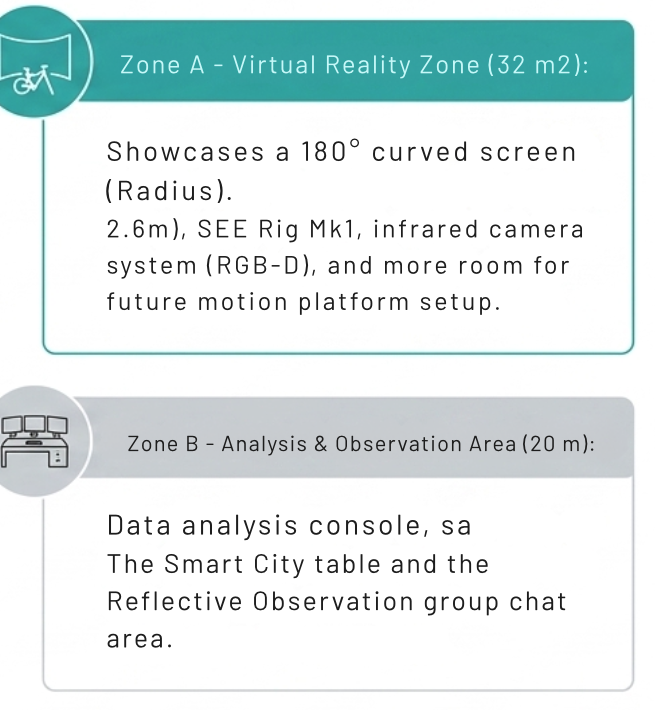
The proposed product converts Room E.401 into a two-zone research sandbox: Zone A for 180° immersive cycling practice and Zone B for observation, debrief, data review and group discussion.
Sản phẩm đề xuất chuyển phòng E.401 thành sandbox nghiên cứu hai khu: Zone A cho thực hành đạp xe immersive 180° và Zone B cho quan sát, debrief, rà soát dữ liệu và thảo luận nhóm.
A 180° curved screen, SEE Rig Mk1, RGB-D camera system and space for a future motion-platform setup.
Màn hình cong 180°, SEE Rig Mk1, hệ thống camera RGB-D và không gian dự phòng cho motion platform tương lai.
A console and group-observation area for live debrief, reflective discussion and rapid data review.
Khu console và quan sát nhóm để debrief trực tiếp, thảo luận phản tư và rà soát dữ liệu nhanh.
E.401 is designed as the controlled room where students experience the immersive cycling task. The session then flows into LELP, where survey data, sensor data, route exposure and school context can be cleaned, compared and visualised through the EVOLVE/R2S Map layer.
E.401 được thiết kế như phòng kiểm soát để học sinh trải nghiệm bài mô phỏng đạp xe. Sau phiên học, dữ liệu đi vào LELP, nơi dữ liệu khảo sát, cảm biến, phơi nhiễm tuyến đường và bối cảnh trường học được làm sạch, so sánh và trực quan hoá qua lớp EVOLVE/R2S Map.
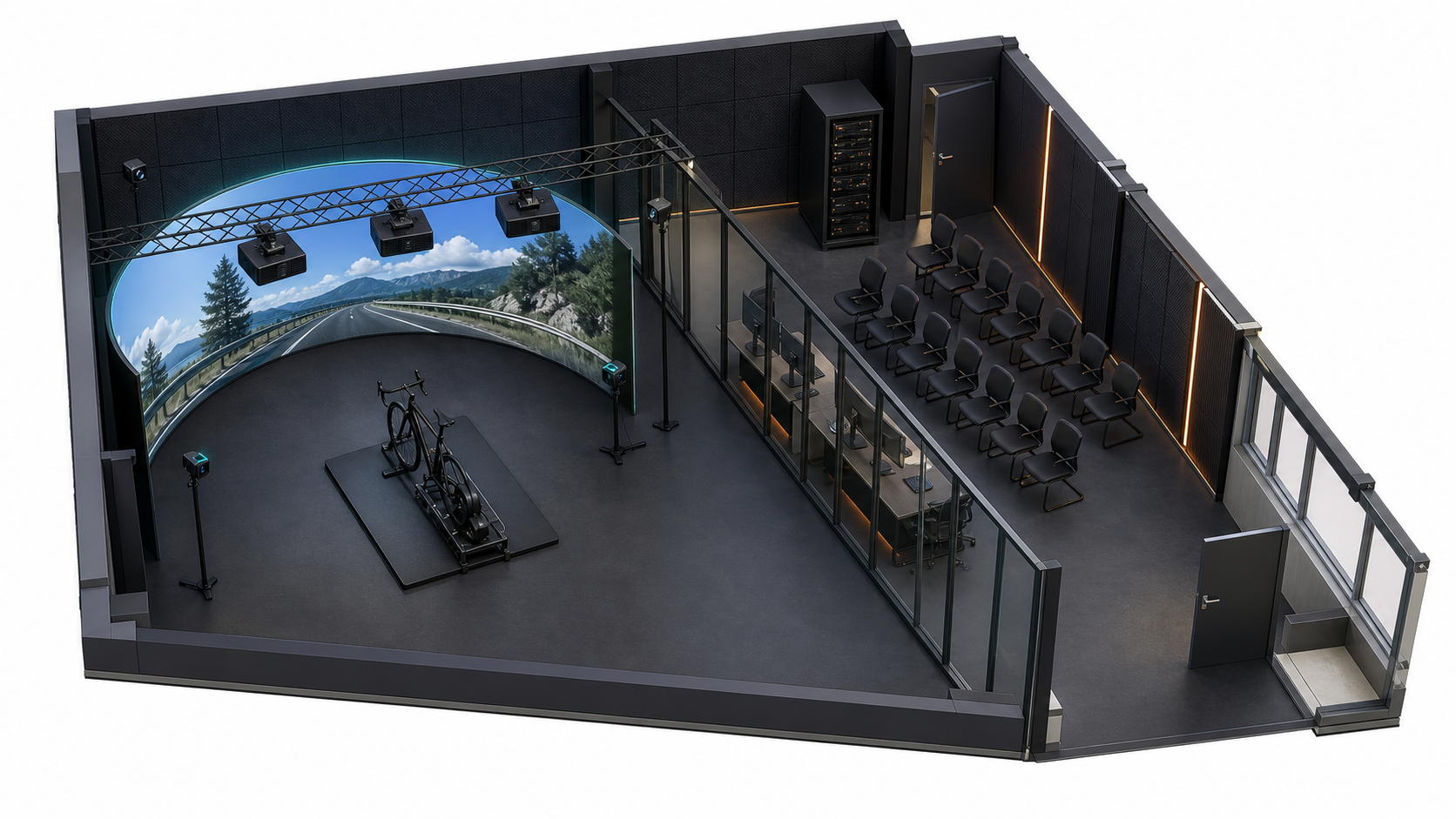
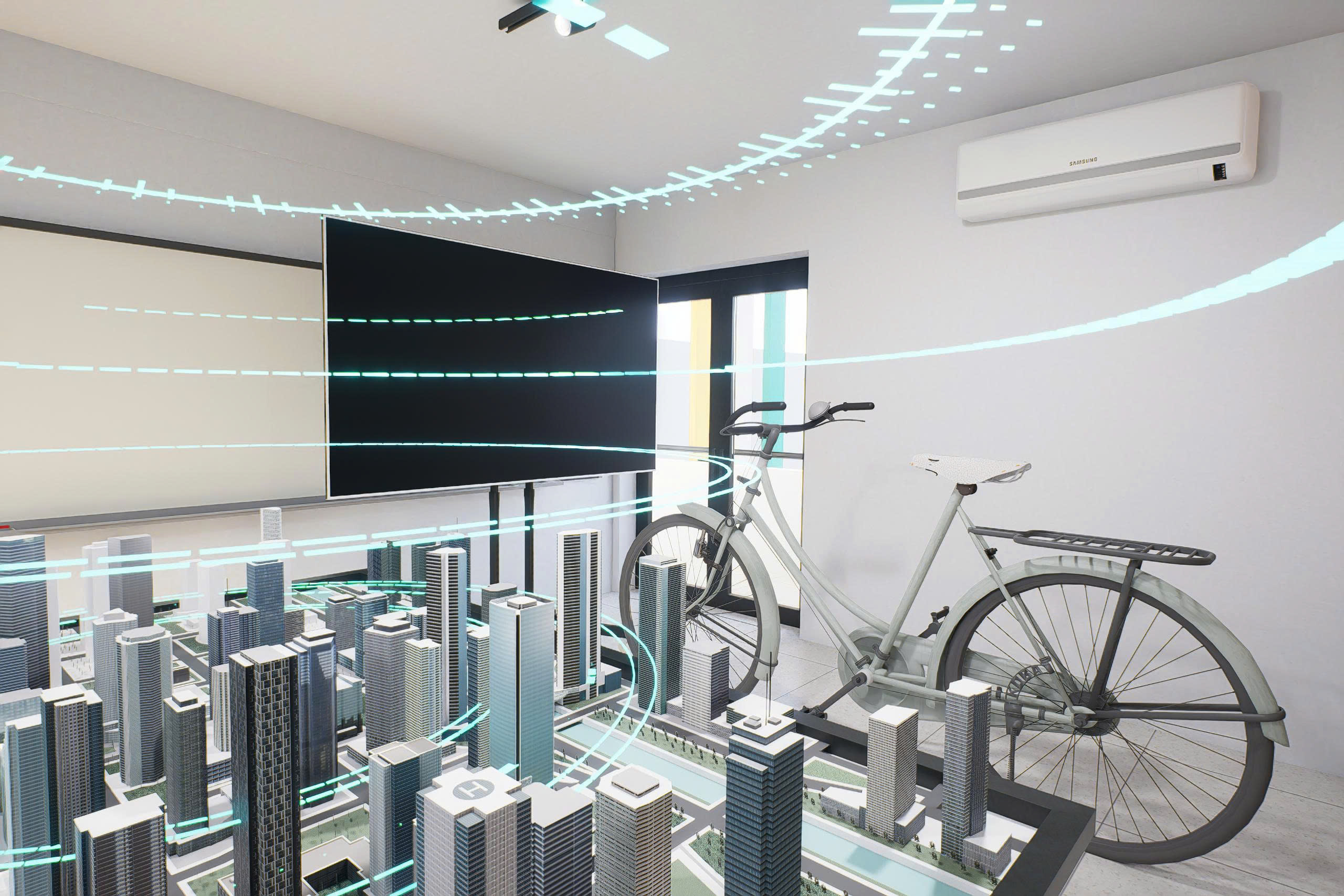
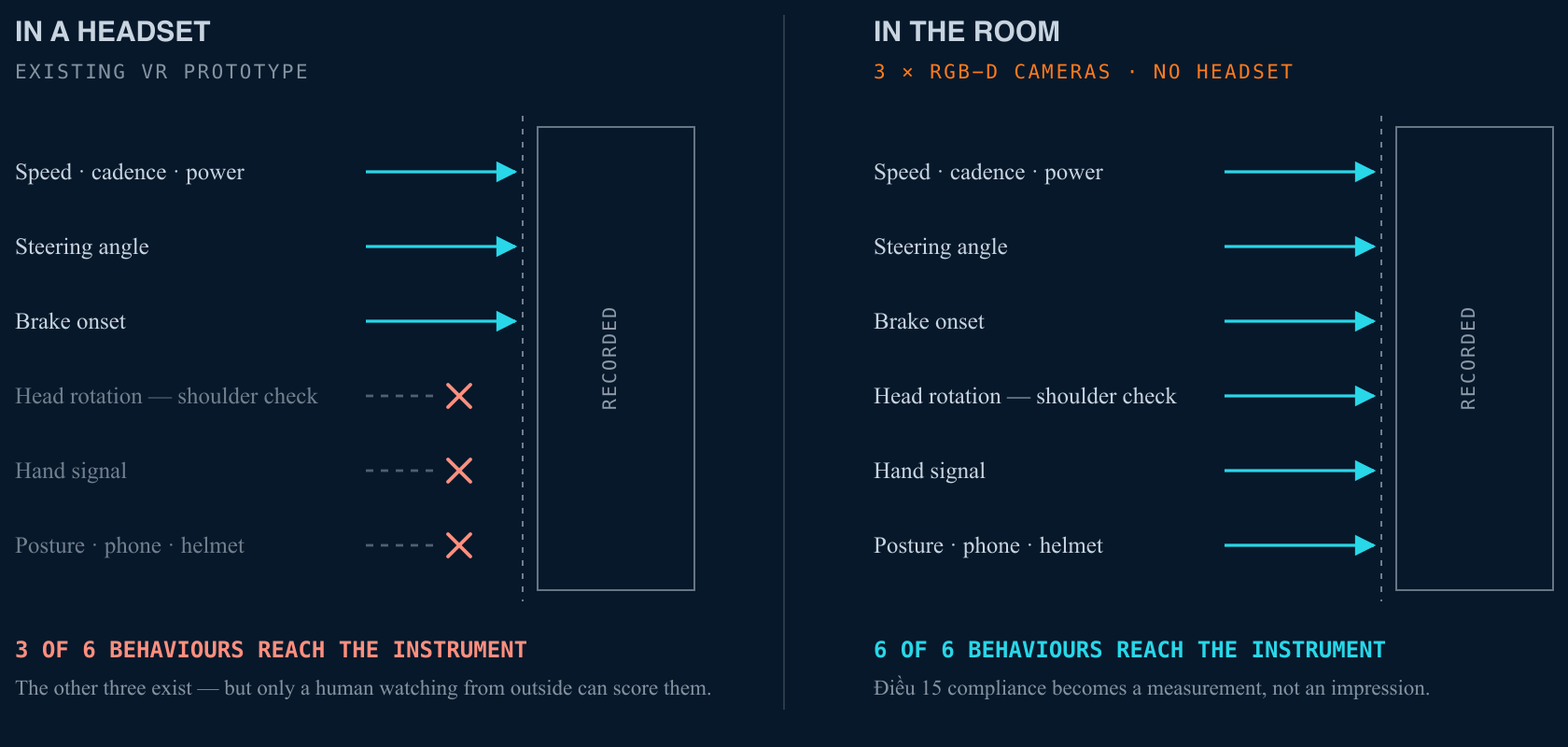
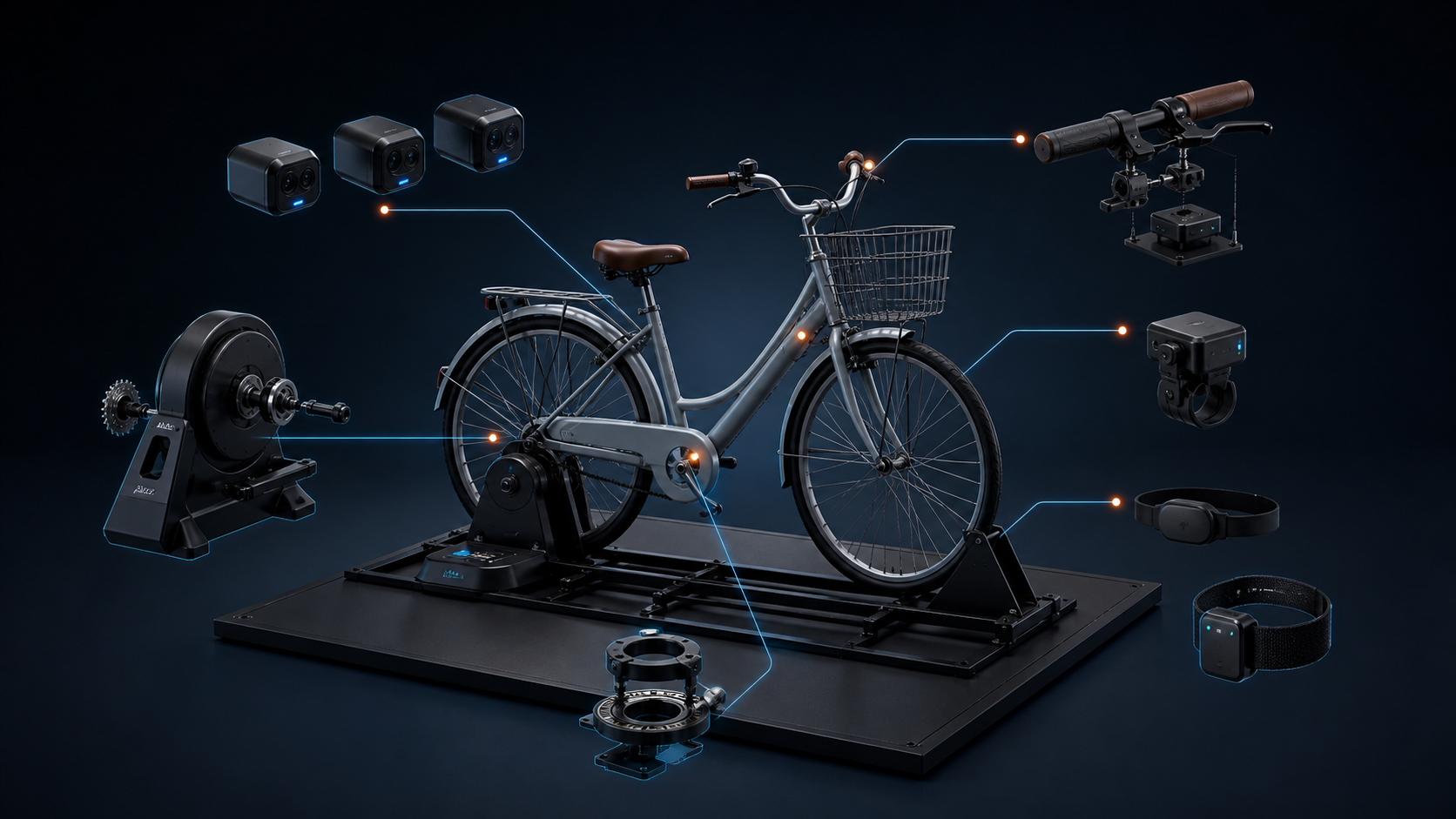
Instead of putting adolescents inside a headset, the improved system places them on a real bicycle inside a 180-degree projected or LED room. Their visible actions — pedalling, steering, braking, head checks, shoulder checks and hand signals — can be observed, measured and mapped to Vietnamese traffic-safety rules.
Thay vì cho học sinh đeo kính VR, hệ thống cải tiến đặt người học trên một chiếc xe đạp thật trong phòng chiếu hoặc LED 180 độ. Các hành vi nhìn thấy được — đạp, đánh lái, phanh, quay đầu quan sát, kiểm tra vai và ra tín hiệu tay — có thể được quan sát, đo lường và đối chiếu với quy tắc an toàn giao thông Việt Nam.
Students can practise risky traffic moments safely, with less simulator sickness, shorter familiarisation time and immediate group debrief.
Học sinh được luyện các tình huống nguy hiểm một cách an toàn, giảm say mô phỏng, rút ngắn thời gian làm quen và có thể thảo luận nhóm ngay.
Signal use, speed, lane position, yielding, red-light compliance, near-miss response and scenario-level “diamond” scoring.
Tín hiệu tay, tốc độ, vị trí làn, nhường đường, tuân thủ đèn đỏ, phản ứng trước suýt va chạm và điểm “diamond” theo kịch bản.
A safer training environment, richer behavioural evidence and a reusable school-facing demonstration for education and policy partners.
Một môi trường luyện tập an toàn hơn, bằng chứng hành vi phong phú hơn và mô hình trình diễn có thể dùng với trường học và đối tác chính sách.
LELP sits inside PKG 3 — EVOLVE. It connects a learner’s profile, travel mode, school context, survey responses, simulator sessions and route-level risk exposure, then turns them into dashboard-ready evidence for R2S Map.
LELP nằm trong PKG 3 — EVOLVE. Nền tảng này liên kết hồ sơ người học, phương tiện di chuyển, bối cảnh trường học, phản hồi khảo sát, phiên mô phỏng và mức phơi nhiễm rủi ro theo tuyến, rồi chuyển thành bằng chứng sẵn sàng cho dashboard R2S Map.
Participant registry, survey engine, session ingest, researcher dashboard, R2S Map, teacher view and parent view.
Hồ sơ người tham gia, bộ khảo sát, nhận dữ liệu phiên học, dashboard nghiên cứu, R2S Map, giao diện giáo viên và phụ huynh.
Pseudonymised learner records, consent-gated video, separated identity mapping and route coarsening for sensitive home/school areas.
Hồ sơ ẩn danh hoá, video theo đồng ý, tách bảng định danh và làm mờ tuyến gần nhà/trường để bảo vệ dữ liệu nhạy cảm.
Comparable evidence across packages, better targeting of interventions and clearer communication with educators, planners and policymakers.
Bằng chứng có thể so sánh giữa các gói, nhắm can thiệp chính xác hơn và truyền đạt rõ hơn với nhà giáo dục, nhà quy hoạch và nhà hoạch định chính sách.
Intern topics are designed as proposal streams. Students can join an operating flagship, or propose a focused sub-topic under the SEE research topics where new evidence, prototypes or datasets are still needed.
Các vị trí intern được thiết kế như những hướng đề xuất. Sinh viên có thể tham gia dự án phát sáng đang vận hành, hoặc đề xuất một sub-topic cụ thể trong các chủ đề nghiên cứu SEE còn cần thêm bằng chứng, prototype hoặc dữ liệu.
Build traffic scenarios, simulator logic, projected-room interaction, smart-trainer control and the rule-based scoring layer for R2S Immersive Cycling.
Phát triển kịch bản giao thông, logic mô phỏng, tương tác phòng chiếu, điều khiển smart trainer và lớp chấm điểm theo luật cho R2S Immersive Cycling.
subtopic 1 + subtopic 3Work on sensor streams, pose/gesture detection, braking and steering telemetry, data cleaning, synchronisation and research-ready datasets.
Xử lý dòng dữ liệu cảm biến, nhận diện tư thế/cử chỉ, dữ liệu phanh và đánh lái, làm sạch, đồng bộ và tạo bộ dữ liệu phục vụ nghiên cứu.
subtopic 2 + subtopic 3Design surveys and experiments, support school pilots, analyse hazard perception, behavioural change, situational awareness and transfer-to-road outcomes.
Thiết kế khảo sát và thí nghiệm, hỗ trợ pilot tại trường, phân tích nhận thức nguy hiểm, thay đổi hành vi, nhận thức tình huống và chuyển hoá ra đường thật.
subtopic 1 + subtopic 2Develop the participant registry, bilingual survey engine, dashboard views, R2S Map layers, school/parent interfaces and privacy-aware data export.
Phát triển hồ sơ người tham gia, bộ khảo sát song ngữ, dashboard, lớp bản đồ R2S Map, giao diện trường/phụ huynh và xuất dữ liệu có kiểm soát riêng tư.
subtopic 2 + subtopic 3The SEE Living Lab is grounded in a Location-based Experiential Learning Platform (LELP) — a conceptual model that situates learners within their real mobility environment and tracks how education shapes behaviour at each stage of development.
Learners under 18 years old who travel to and from school independently — as active road users across multiple vehicle types and travel modes.
LELP distinguishes learners who access innovative educational interventions from those who do not — allowing the lab to measure the causal effect of the R2S packages on real-world behaviour change.
Both pathways are tracked through the LELP platform's location-aware data layer, linking behavioural outcomes to real routes, intersections, and risk zones.
Deploy R2S Education gamified platform. Baseline surveys of learner knowledge, attitudes and travel behaviour across partner schools in Ho Chi Minh City.
Build and pilot the R2S VR Cycling hybrid simulator. Measure transfer from virtual hazard-perception practice to real-world scanning behaviour.
Launch R2S Map spatial analytics dashboard. Link crash data, school catchments and LELP location data to generate route-level safety insights.
Scale the LELP model to additional cities and partner nations (India, Nepal, ASEAN) via the Spatial Problem–Solution Mapping framework.
All SEE Lab-affiliated publications drawn from the MOVE System research portfolio, spanning gamified e-learning, behavioural science, spatial analytics, and cross-national road-safety education.
SEE is designed as a shared infrastructure — every actor in the street ecosystem gets something measurable back.
One platform connects learning, behavioural evidence, spatial analytics, and policy action for the school-zone ecosystem.
Sequential rollout of the four R2S packages, with each stage informing the next.
Deploy the gamified e-learning platform across partner schools in Ho Chi Minh City; baseline behavioural surveys.
Build and pilot the hybrid VR cycling simulator; measure transfer from virtual practice to real-world scanning behaviour.
Launch the spatial analytics dashboard linking crash data, school catchments and walkability audits for public use.
Scale the model to additional Vietnamese cities and partner nations (India, Nepal, ASEAN) via the problem–solution mapping framework.
The LELP (Learning and Engagement for Life and Pedestrian safety) platform is the doctoral research output of Phan Le Truong An (An Le), PhD Candidate at ISCM, UEH — directly powering the data-driven backbone of the SEE Living Lab.
The LELP (Location-based Experiential Learning Platform) is An Le's doctoral research project at UEH ISCM. It bridges two critical gaps in Vietnamese road-safety education: the absence of technology-enhanced, evidence-based learning environments for young road users, and the lack of spatially-grounded behavioural outcome data linking educational interventions to real street-level safety.
LELP integrates the four SEE Lab packages — gamified e-learning (R2S Education), immersive VR practice (R2S VR Cycling), GIS-based analytics (R2S Map), and cross-city scaling (SPSM) — into a unified platform that tracks learner trajectories from classroom instruction through to measurable on-road behaviour change. The dashboard below visualises research progress, participant data, and outcomes in real time.