
ISCM – NUS International Workshop: Urban Data Visualization 2026


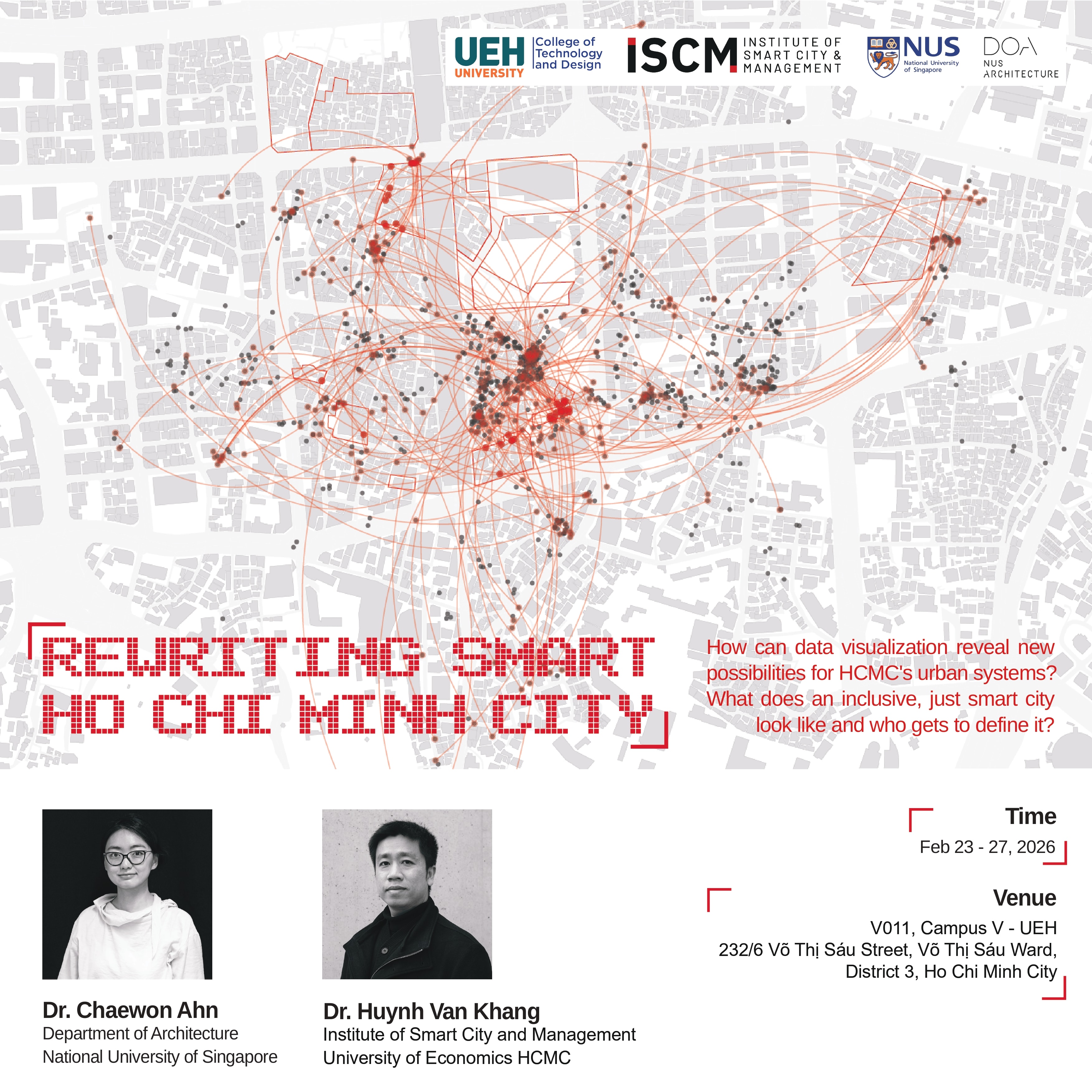
The workshop “REWRITING SMART HO CHI MINH CITY” is co-organized by University of Economics Ho Chi Minh City and National University of Singapore. Over the course of one week, participants will directly collect urban data, experiment with methods of spatial documentation through images, movement, and field-based experience, and analyze smart-city development strategies in Ho Chi Minh City within the context of digital transformation and data-driven governance.
The program goes beyond lectures or technical exercises. It is a journey into the city to observe, document, analyze, and visualize, revealing that behind every “smart” system lie layers of reality that remain unmeasured and communities that are not fully seen. As cities increasingly operate through technology and algorithms, the workshop raises a central question: Who does the smart city truly serve, and who has the power to decide how it is measured and managed?
Program Information
Date: 23–27 February 2026
Venue: Room V011, UEH Campus – V232/6 Vo Thi Sau, Xuan Hoa Ward, District 3, Ho Chi Minh City
Registration: Link
The workshop is led by Dr. Chaewon Ahn, Lecturer at the Department of Architecture, National University of Singapore (NUS) and Co-Director of the NUS Civic Resilience Lab. She is a researcher specializing in data visualization and participatory data-collection methods. Her work focuses on how knowledge about the city is produced and used across the relationships between communities, governance, smart-city models, and urban information systems. With a background in architecture, planning, and information systems, Dr. Ahn approaches data not only as a management tool but also as a medium for dialogue and critical engagement in planning, contributing to community empowerment.
Joining as co-instructor is Dr.Arch. Huynh Van Khang, lecturer at the Institute of Smart City and Management, University of Economics Ho Chi Minh City (UEH); founder of Passive Design Laboratory (PDL); and member of the Association of Architectural Design of Nippon (ADAN) and the Architectural Institute of Japan (AIJ). With expertise in climate-adaptive architecture, building performance simulation, ethnographic research, and heritage conservation, he brings a perspective that connects technology, environment, and local context. As a two-time recipient of Japan’s Good Design Award for climate-adaptive passive projects in tropical hot–humid regions, he helps clarify the relationship between urban data and the specific climatic and social conditions of Ho Chi Minh City.
Limited slots available.
Application deadline: 21 Feb 2026.